
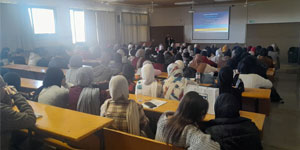
In line with its mission to lead the digital transformation in the medical sector, PUA’s Faculty of Applied Health Sciences Technology delivered a specialized seminar titled “AI Applications in Healthcare”. The event aimed to highlight the technological revolution in health systems and how to leverage it to enhance patient care quality.
the seminar featured Dr. Ahmed Hawash, Consultant of Critical Care Medicine at Alexandria University. The lecture explored pivotal AI applications, including:
- Early and Accurate Diagnosis using Machine Learning techniques.
- Advanced Medical Imaging and Radiology Analysis with high-precision algorithms.
- Smart ICU Management and clinical decision support during critical interventions.
The seminar also addressed the ethical and legal challenges surrounding medical data privacy, emphasizing that AI serves as an “augmenting tool” for clinicians rather than a replacement. The session concluded with interactive discussions between students and faculty, highlighting the necessity of integrating data science and AI into academic curricula to prepare a new generation of medical technologists capable of leading the future of digital healthcare.
In line with its mission to lead the digital transformation in the medical sector, PUA’s Faculty of Applied Health Sciences Technology delivered a specialized seminar titled “AI Applications in Healthcare”. The event aimed to highlight the technological revolution in health systems and how to leverage it to enhance patient care quality.
the seminar featured Dr. Ahmed Hawash, Consultant of Critical Care Medicine at Alexandria University. The lecture explored pivotal AI applications, including:
- Early and Accurate Diagnosis using Machine Learning techniques.
- Advanced Medical Imaging and Radiology Analysis with high-precision algorithms.
- Smart ICU Management and clinical decision support during critical interventions.
The seminar also addressed the ethical and legal challenges surrounding medical data privacy, emphasizing that AI serves as an “augmenting tool” for clinicians rather than a replacement. The session concluded with interactive discussions between students and faculty, highlighting the necessity of integrating data science and AI into academic curricula to prepare a new generation of medical technologists capable of leading the future of digital healthcare.